
AllWatch
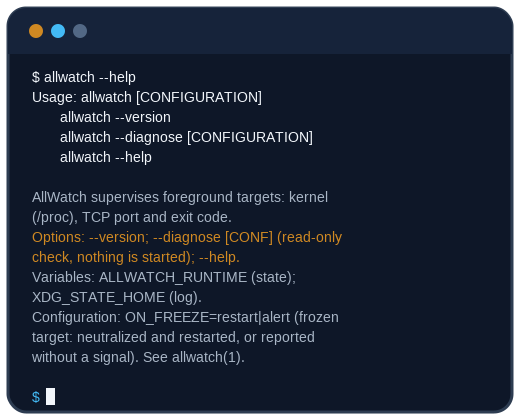
AllWatch keeps a Linux process alive without asking that process to cooperate. It starts the target in the foreground, remembers the PID the kernel assigned, and checks three things only: the process still exists in /proc, its TCP port still accepts a connection, and the exit code it left when it ended. The target is a black box: it does not register, does not send status messages and does not need to know that AllWatch exists.
The supervisor is about one hundred and seventy useful lines of Bash. It has no database, no daemon of its own, no network protocol and no dashboard. It restarts a target according to always, on-failure or transient, and it stops restarting a target that restarts too often in a short window.
The packages for Debian, Ubuntu, Fedora, openSUSE Leap and Arch Linux install the supervisor, a systemd service and the manual page in five languages. The announced level is installation and diagnosis validated in a container, on Debian 12 and 13, Ubuntu 22.04 and 24.04, Fedora 43, 44 and 45, openSUSE Leap 16.0 and Arch Linux. The Debian package was also run for real: installed as a service on a Raspberry Pi 4 under Debian 13, with a real application, for a two-hour run and then a six-hour run (95 events, 95 passed, none failed), then removed and purged.
Where to go next
- Installation
Install AllWatch on Debian, Ubuntu, Fedora, openSUSE Leap or Arch Linux, add a target, and check the service.
- How it works
The four states of a target, the restart policies and the anti-loop window.
- Compatibility
Debian, Ubuntu, Fedora, openSUSE Leap and Arch Linux are the published platforms; what the packages check and what they do not.